

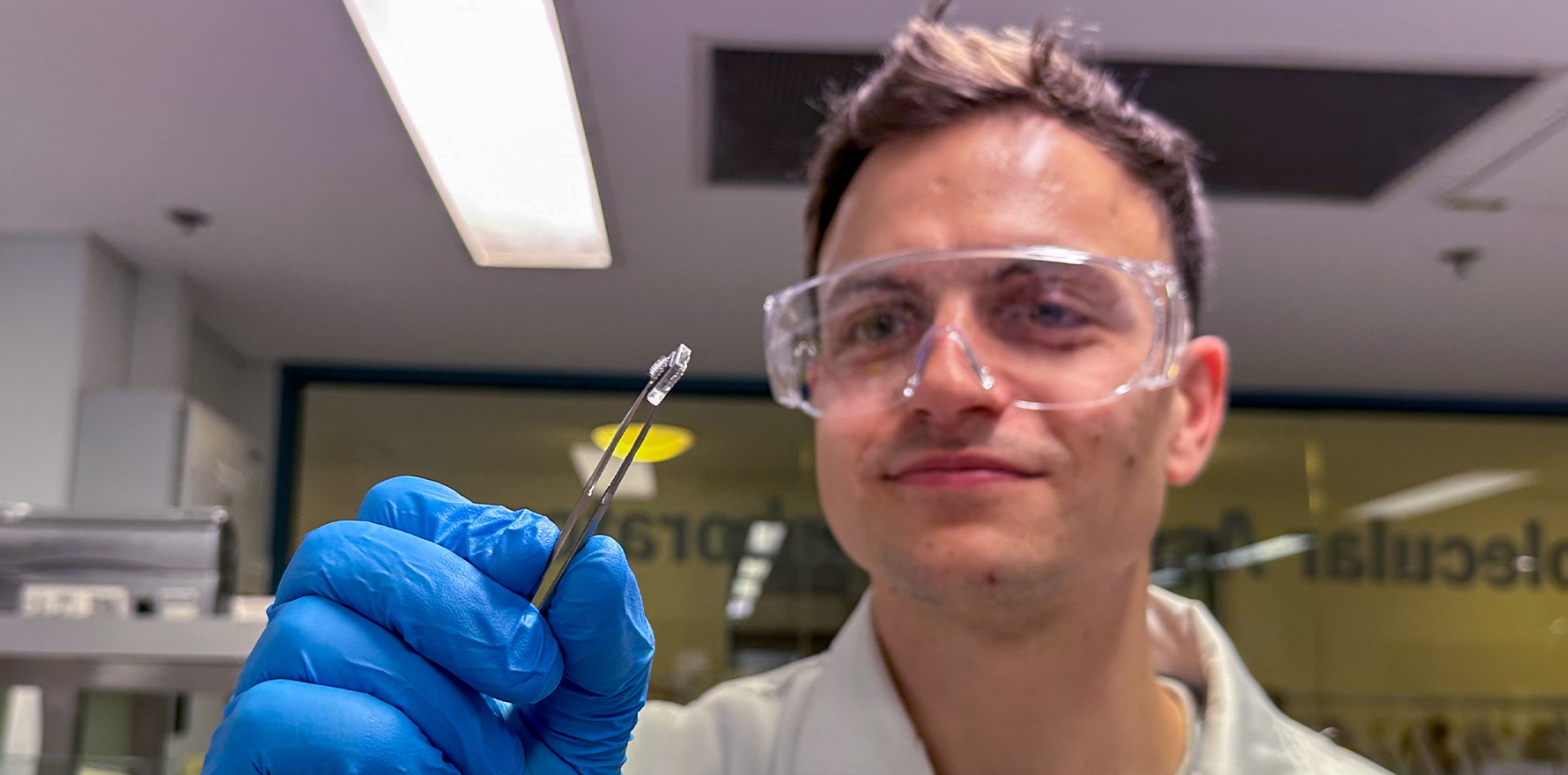
A closer look at what happens to mRNA nanoparticles as they dry could help turn dissolvable skin patches into a more practical alternative to ultra-cold vaccine storage.
A dissolvable vaccine patch that can survive outside the cold chain has moved a step closer to reality, with researchers identifying how to protect the fragile nanoparticles carrying mRNA through the drying process.
The RMIT University-led research, conducted with the Massachusetts Institute of Technology and Harvard Medical School, found that both lipid nanoparticle design and the amount of polymer surrounding the particles were critical to preserving mRNA integrity and biological activity.
The study, published in Advanced Functional Materials, takes aim at one of the biggest barriers to wider mRNA vaccine use: demanding cold-chain storage requirements.
Current mRNA vaccines are typically stored at temperatures ranging from -90°C to -15°C, making reliable cold-chain infrastructure a prerequisite for distribution.
The researchers said dry formulations could potentially extend stability at higher temperatures by removing the water that contributes to vaccine degradation.
The approach uses microneedle array patches containing hundreds of tiny projections that penetrate the skin and dissolve, releasing mRNA-loaded lipid nanoparticles (LNPs). Besides potentially easing storage and transport requirements, the technology offers needle-free administration with minimal pain and no sharps waste.
But drying LNPs is not simply a matter of removing water. The self-assembled particles can aggregate, collapse, and reorganise during drying and subsequent processing, potentially altering their structure, mRNA loading, and activity.
Lead author Dr Brendan Dyett, from RMIT, said understanding those changes was an important step towards developing vaccines that were easier and cheaper to distribute.
“Many mRNA vaccines need to be stored at very low temperatures, adding cost and complexity to transport and delivery,” he said.
“Our study helps explain how the particles that carry mRNA respond to drying and rehydration, which is an important step towards designing future vaccine patches that are more stable and practical to distribute.”
Using cryogenic transmission electron microscopy, small-angle X-ray scattering, and other techniques, the team followed the nanoparticles before drying, in the dry polymer matrix and after rehydration.
They found that LNPs underwent substantial structural rearrangement during the process, but that sufficient polymer could prevent excessive aggregation and help the particles regain important structural features when rehydrated.
The researchers used a dissolvable 50:50 blend of polyvinylpyrrolidone and polyvinyl alcohol, known as PVPVA, as the polymer matrix.
Earlier screening had identified the blend as capable of balancing protein expression, mechanical properties and drying time. Polymer concentration proved crucial.
At polymer-to-mRNA ratios above 320:1, aggregation was mitigated and most particles in the dried matrix remained below 500nm. The study also found that mRNA integrity was preserved at ratios greater than 160:1, while low-polymer formulations produced unstable LNPs, more unencapsulated mRNA and greater susceptibility to mRNA degradation.
The composition of the nanoparticles themselves mattered too. Increasing the ratio of ionisable lipid nitrogen to mRNA phosphate – the N/P ratio – increased mRNA encapsulation efficiency. Higher-N/P LNPs also appeared more robust during recovery after drying.
At low polymer concentrations the researchers detected increased particle coalescence as the vaccine dried. Increasing polymer content appeared to shield LNPs from aggregation and increase viscosity, reducing the likelihood that particles would merge.
Those microscopic differences translated into biological effects.
When patches containing luciferase mRNA were applied to mice, increasing the polymer:mRNA ratio from 32:1 to 160:1 or higher produced a marked increase in expression, after which performance was broadly similar.
The team also found that manufacturing technique could make or break the mRNA payload.
Microneedle patches were often manufactured through several deposition and drying cycles, but the researchers found mRNA integrity fell dramatically after a second drying cycle.
The researchers redesigned the process to use a more concentrated vaccine ink and a single drying step.
Patches made with one drying cycle produced significantly greater luciferase expression in mice than patches manufactured using two drying cycles.
Related



In a further experiment, patches carrying mRNA encoding the SARS-CoV-2 spike receptor-binding domain generated pseudovirus neutralising titres in rats comparable with intramuscular injections using similar or greater doses.
The findings build on previous MIT work showing that mRNA-containing microneedle patches could be printed and stored at room temperature. Rather than simply demonstrating that a dry patch can work, the latest research provides a mechanistic picture of what happens to LNPs as water disappears and returns.
That distinction could prove important when adapting the technology to different mRNA vaccines and therapeutics, the researchers said.
Lead researcher, RMIT Distinguished Professor Calum Drummond AO said the findings represented an important step towards making vaccines easier and cheaper to distribute.
“This research is helping build the foundation for microneedle patches that could make advanced vaccines and therapies simpler to use and easier to access,” he said.
“The long-term goal is to support technologies that are not only effective, but practical for the places and communities that need them most.”
The implications could extend beyond convenience. Cold-chain requirements add substantial complexity to vaccine transport and storage and can be particularly difficult to meet in lower-resource settings.
According to WHO and UNICEF figures cited by RMIT, 14.3 million children worldwide received no routine vaccinations at all in 2024.
There is still plenty of work between the laboratory findings and a shelf-stable mRNA vaccine patch.
The study used model mRNA systems and preclinical animal experiments, and the researchers said further immunogenicity studies were needed to establish how optimised nanoparticle structures affected the quality and magnitude of immune responses.
They also identified lipid composition, cholesterol crystallisation and endosomal escape as potential targets for improving performance after drying.
Next steps included further optimising the nanoparticle and patch formulations, testing how the design translated to immune responses, and exploring whether similar approaches could be applied to other mRNA medicines.
