


Reports released in February this year show the latest national trends in chronic respiratory conditions, with comparisons to the start of the century.
The past 20 years have seen significant changes in the chronic respiratory condition landscape, according to latest data from the Australian Institute of Health and Welfare.
Between 2003 and 2024, there were huge reductions in fatal disease burden attributable to chronic obstructive pulmonary disease (COPD) in males and asthma in females, while the prevalence of allergic rhinitis rose steeply.
Let’s get into some statistics.
Chronic respiratory conditions
There was an overall decline in the rate of respiratory disease burden between 2003 and 2024, with a 6.2% drop after adjusting for changes in population age structure. The AIHW attributed this largely to an 18% decrease in the rate of fatal burden.
In 2024, respiratory conditions made up 7.2% of the nation’s total disease burden, accounting for 8.4% of non-fatal burden and 5.7% of fatal burden. Nearly three quarters of fatal burden was attributable to COPD, while non-fatal burden was dominated by asthma (51%).
In 2023–24, 4.1% of all hospitalisations were a respiratory condition as the principal diagnosis.

A snapshot from the 2022 National Health survey showed allergic rhinitis was the most common chronic respiratory condition that year (24%), followed by asthma (11%) and chronic sinusitis (8.3%). Around 32% of males and 35% of females were estimated to be living with a chronic respiratory condition.
Respiratory conditions were the underlying cause and associated cause of 8.3% and 20% of all deaths, respectively, in 2023. After adjusting for changes in population age structures between 2013 and 2023, mortality rates for respiratory conditions as the underlying cause decreased from 45 to 42 per 100,000 population.
COPD
Between 2003 and 2024, the rate of fatal burden attributable to COPD declined by a whopping 31% in males but increased slightly among females (1.5%). Non-fatal disease burden declined by 7.5% overall in that time.
In 2022, nearly 5% of people aged 45 years and over were estimated to be living with COPD, 88% of whom were living with one or more additional chronic conditions and in 2024, COPD accounted for around 4% of the nation’s total disease burden and nearly 40% of non-fatal respiratory disease burden.
COPD represented 1.3% of all hospitalisations in 2023-24, a slight increase to 256 per 100,00 population from 2022-23 (248 per 100,000). Despite the current uptick, hospitalisations are still lower than they were in the years before covid.
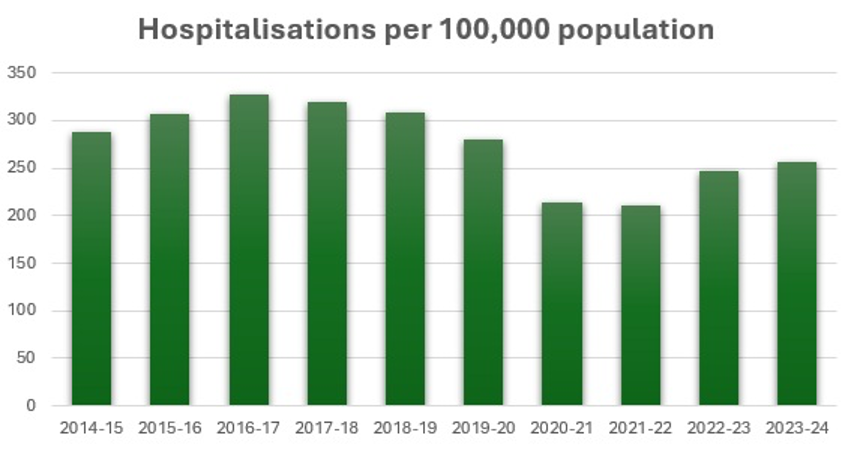
The hospitalisation rate among First Nations people was 5.8 times the rate among non-Indigenous Australians in 2023-23, after adjusting for differences in age, and the death rate was 3.1 times higher.
In 2023, COPD was the underlying cause and associated cause of 49% and 29% of all respiratory deaths, respectively.
Related



Asthma
From 2003 to 2024, the overall rate of non-fatal burden due to asthma increased by around 11%, with a larger increase noted for males (15%). Over the same period, the rate of fatal burden decreased by around 19% overall but was particularly significant with females (27%).
The 2022 survey estimated that 11% of the population were living with asthma.
Overall, the AIHW reported asthma to be progressing well, with hospitalisations decreasing from 157 per 100,000 hospitalisations in 2017–18 to 119 per 100,000 in 2023–24. Emergency department visits due to asthma decreased but 65 per 100,000 in the same period.
There was a slight increase in deaths in those aged 35 to 54 years between 2017 to 2023, from 1.0 per 100,000 population to 1.1, and preventer adherence dropped by 2%.
First Nations people experienced a greater asthma disease burden, with a hospitalisation rate and death rate 1.8 times and 3.4 times higher, respectively, than non-Indigenous Australians.
In 2024, asthma accounted for 2.5% of the total national disease burden and was the leading cause of disease burden in children aged 1–9 years. Nearly half of asthma hospitalisations in 2023-24 were for those aged under 14 years.
Allergic rhinitis
Nearly a quarter of Australians were living with allergic rhinitis in 2022, with children aged 14 years or under being less likely to have it than any other age group. The hay fever dataset ran from 2001 to 2022, which showed a significant increase in prevalence from 15.5% to 23.9%.

The proportion of First Nations people with allergic rhinitis rose from 14% to 19% from 2018−19 to 2022−23, and rates differed significantly for location; 21% in non-remote areas and 7.7% in remote areas.
The full reports can be accessed here.
